I have a growing suspicion that we’re going to have to become rather more discerning about what we see on social media. It’s already awash with AI-generated photographs, videos and stories, and the worrying thing isn’t necessarily that they’re being created, but how readily they’re being shared, believed and sometimes used to stir up arguments or misrepresent what’s actually happening.
Of course, questioning the authenticity of photographs isn’t entirely new. Long before AI-generated images became commonplace, there was Photoshop. Some photographers used it extensively to manipulate or enhance their images, and it wasn’t unusual to hear someone dismiss an unusual photograph with, “Oh, that’s got to be Photoshopped.”
I know this only too well. A photograph I took 13 years ago, capturing the moment a shotgun was fired, has attracted plenty of accusations of digital trickery. It wasn’t Photoshopped. It was a combination of a fast shutter speed, timing and being in the right place at the right moment. Apparently, that was sometimes harder for people to believe than a bit of digital manipulation!
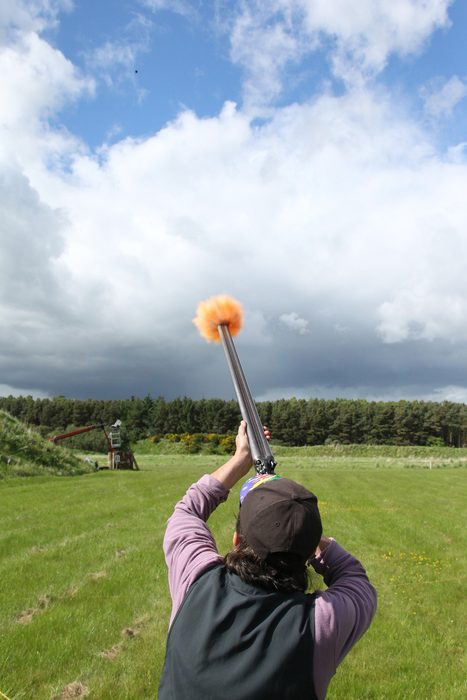
The countryside is certainly not immune to today’s developments. Wildlife photographs, unusual animal sightings, dramatic rural incidents and images of countryside life can all be manufactured with increasing ease. Some are simply amusing, but others are presented as genuine events or evidence, when they’re nothing of the sort. Some are even being used to stir up arguments and influence opinions on subjects that already attract strong feelings, from wildlife management and deer stalking to farming and land use. And it’s not just about photographs. AI can now replicate voices, faces and writing styles, making it increasingly difficult to know whether we’re dealing with a real person or an artificial creation.
Today, I read an interesting piece in The Deep View about World ID, a technology being developed to establish whether someone is a unique human being. It involves iris scanning and raises some interesting questions about identity, privacy and how we might prove we’re human in an increasingly artificial online world. It brings me back to something I wrote earlier this year for the British Deer Society, Who Do We Trust?. Identity, experience and authenticity are all becoming increasingly important when so much of what we encounter online can be manipulated or manufactured.
I’m certainly not anti-AI. Far from it. I’m fascinated by the technology and the possibilities it offers. But there’s a difference between using it as a tool and presenting something artificial as genuine. I sometimes joke that I should attach my own version of a human verification badge to everything I post: #ThisIsReal #AuthenticLindaMellorContentAlways. It’s tongue-in-cheek, but there’s a serious thought behind it. As the distinction between human-created and AI-generated content becomes harder to recognise, perhaps we’ll increasingly want some way of identifying the real thing.
World ID is exploring that challenge through technology. My version is rather less sophisticated, but the principle is interesting: knowing that there’s a real human being behind the content, rather than an artificial identity or manufactured online presence.
It might sound a little far-fetched, but I suspect the ability to distinguish the real from the artificial, and eventually to prove there’s a real human behind the screen, is going to become a much bigger part of our online lives.
And the countryside, for all its remoteness, won’t be escaping it.